

Last winter I was stuck in traffic, staring at the wheels of the truck in front of me, and I had this weird thought: someone thousands of years ago figured this out with nothing but wood, fire, and a lot of trial and error. No YouTube tutorials. No engineering degree. Just a person who got tired of dragging heavy stuff around and decided there had to be a better way.
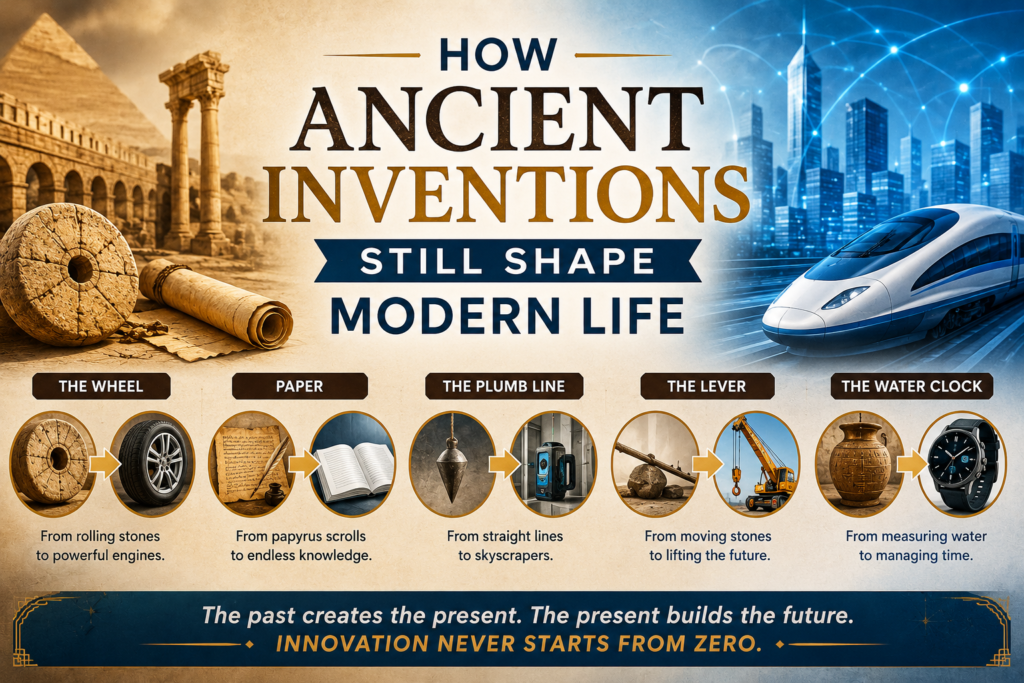
That thought stuck with me for days. So I started paying attention to how much of my everyday life, my phone, my kitchen, my morning coffee routine, actually traces back to something invented centuries or even millennia ago. The more I looked, the more it blew my mind.
This isn’t going to be a dry history lesson. I want to walk you through the ancient inventions that quietly run our modern world, the same way I discovered them, by noticing them in ordinary moments and going “wait, that’s actually really old.”
Why This Topic Actually Matters to Regular People
I used to think history was something you studied for a test and then forgot. My opinion changed after I started a small pottery hobby a couple of years ago.
I bought a cheap wheel off Amazon, some clay, and figured I’d throw a few bowls for fun. My first ten attempts were a disaster. Lopsided, cracked, collapsing mid-spin. I got frustrated and looked up the history of the potter’s wheel just to understand what I was doing wrong.
Turns out the potter’s wheel is around 5,500 years old, first showing up in ancient Mesopotamia. People back then had zero instructional videos and still managed to mass produce pottery good enough to trade across entire regions. That humbled me fast.
It also made me realize something bigger. A huge chunk of what we consider “modern convenience” is really just old ideas wearing new clothes.
The Wheel: Not Just for Cars
Everyone jokes about the wheel being humanity’s greatest invention, but most people don’t actually think about why.
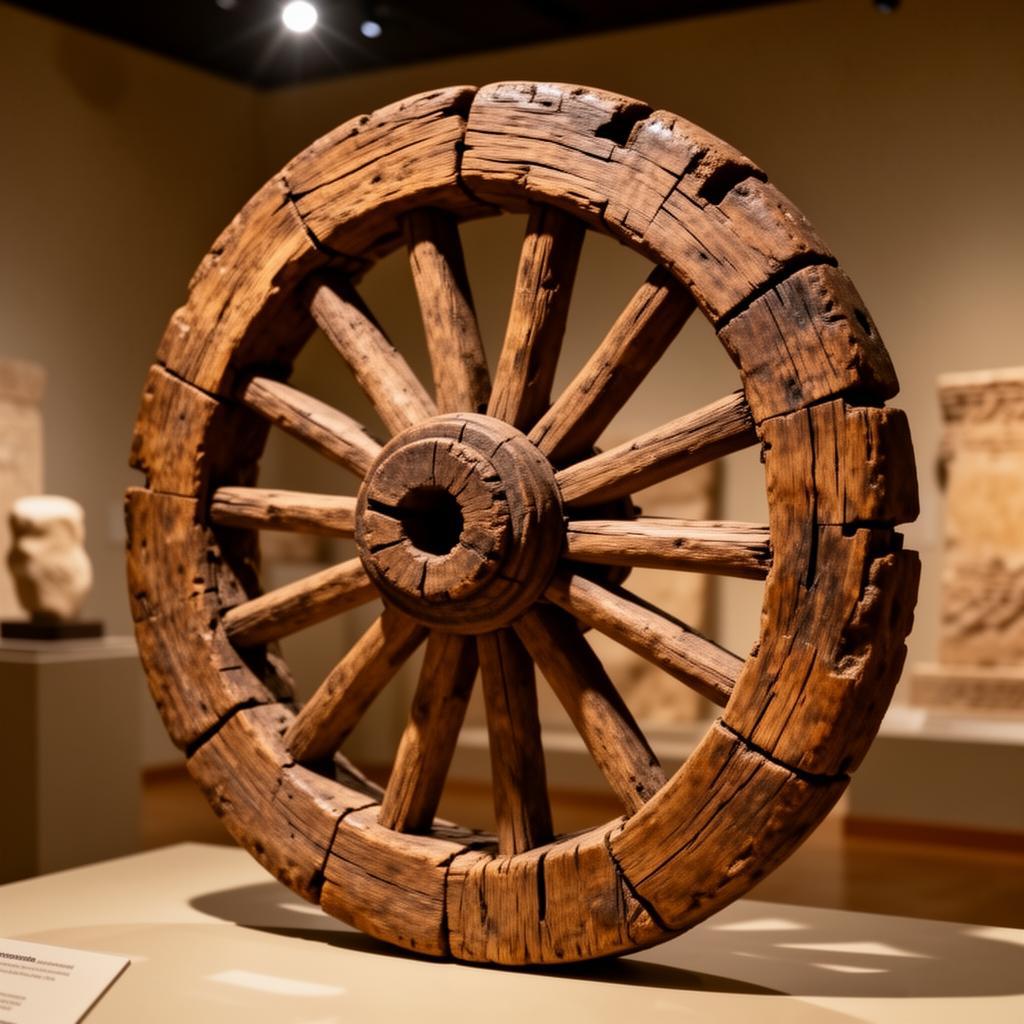
I drive a manual transmission car, and one day my clutch started slipping. The mechanic showed me the flywheel inside the engine, a spinning disc that stores rotational energy. He casually mentioned that the basic physics behind it hasn’t changed since ancient carts rolled through Mesopotamia around 3500 BCE.
Here’s what surprised me most. The wheel wasn’t originally for transportation. It started as a tool for making pottery, exactly the device I struggled with in my garage. Only later did someone attach it to an axle and realize it could move heavy loads.
Think about how many things around you depend on a circle spinning around a fixed point:
- Car tires and engine parts
- Ceiling fans and washing machine drums
- Bicycle wheels
- Even the tiny gears inside your wristwatch
Next time you’re waiting for a bus, glance at the wheels. That simple shape carried entire civilizations, and it’s still carrying you to work.
Aqueducts and the Water That Just Shows Up
I didn’t appreciate this one until I spent a week at a rural cabin with no running water. Every drop had to be hauled in buckets from a nearby stream. By day three, my back hurt and I had a newfound respect for indoor plumbing.

When I got home, I looked into how ancient societies solved this problem, and the Roman aqueduct system genuinely amazed me. Some of these structures moved water across dozens of miles using nothing but gravity and precise slope calculations. No pumps, no electricity, just careful engineering.
The core idea behind aqueducts, moving water efficiently from a source to where people need it, is exactly what modern city water systems still do. Your kitchen faucet is connected to a massive underground network that follows the same basic logic Roman engineers worked out over two thousand years ago.
A few things I learned about ancient water systems that still apply today:
- Gravity is still the cheapest way to move water when possible.
- Filtration matters. Romans used settling tanks to remove debris before water reached homes, similar to how modern treatment plants use sediment tanks.
- Maintenance is everything. Aqueducts failed when neglected, just like pipes burst today when nobody checks them.
Honestly, I complain a lot less about my water bill now that I know what it takes to get clean water to a tap.
Concrete: The Material Holding Up Half the World
I got into a random argument with a contractor friend about which building material was actually the most impressive. He said concrete, and I laughed because it sounded boring. Then he told me something that changed my mind.

Roman concrete, used in structures like the Pantheon, has survived nearly 2,000 years. Modern concrete, in comparison, often starts cracking within a few decades. Researchers have actually studied Roman concrete samples to figure out why it lasted so long, and part of the answer involves volcanic ash and a unique mixing process that allowed the material to self-heal tiny cracks over time.
That conversation made me look at every parking garage and sidewalk differently. Something that seems so plain and modern is actually built on chemistry ancient engineers figured out through decades of experimentation, without labs, without computers, just careful observation.
If you ever walk past an old stone bridge or a weathered building that’s still standing after a century, that’s not luck. That’s inherited engineering knowledge passed down and refined generation after generation.
Paper and the Habit of Writing Things Down
I’m one of those people who still keeps a physical notebook even though I have five productivity apps on my phone. There’s something about writing by hand that helps me think.

That habit connects directly back to papermaking, which was developed in China around 105 CE by a court official named Cai Lun. Before paper became widely available, people used clay tablets, animal skins, or papyrus, all expensive, heavy, or hard to produce in large quantities.
Paper changed the game because it was cheap, lightweight, and could be produced in bulk. That single shift eventually made books, education, and mass communication possible on a scale that wasn’t feasible before.
Every time I scribble a to-do list or my kid brings home a school worksheet, I’m using a direct descendant of that invention. Digital notes are convenient, sure, but paper is still everywhere: receipts, packaging, books, even the toilet paper in your bathroom. That one invention quietly touches almost every part of daily life.
The Compass and Why Your Phone Knows Which Way You’re Facing
A few years ago I went hiking without cell service and relied on an old-school compass my uncle gave me. I felt ridiculous holding this little metal disc like I was in a survival movie, but it worked perfectly.

The compass was developed in ancient China, originally used for divination before people realized its magnetic needle could indicate direction reliably. That discovery eventually revolutionized navigation and made long-distance sea travel dramatically safer.
Here’s the fun part. Your smartphone still has a digital compass built in, using the same basic magnetic principle. Apps like Google Maps or Apple Maps rely on this sensor to orient the map to match the direction you’re facing.
So the next time your phone rotates the map as you turn a corner, that’s ancient Chinese magnetism working quietly behind the scenes of a billion-dollar tech company’s software.
Sundials and Our Obsession With Time
I used to think clocks were a purely modern invention until I visited a botanical garden with an old stone sundial in the center. My daughter asked how it worked, and I honestly didn’t know.

Turns out sundials date back thousands of years, used by Egyptians and Babylonians to divide the day into measurable segments. That basic idea, tracking time by consistent, repeatable measurement, is the foundation every clock and watch still uses today.
Even our 24-hour day and 60-minute hour system comes from ancient Babylonian mathematics, which used a base-60 counting system. Every time you check the time on your phone, you’re using a structure invented before written history as we usually think of it.
Common Mistakes People Make When Thinking About Old Inventions
While researching this topic, I noticed a few patterns in how people misunderstand ancient technology. I made some of these mistakes myself.
Assuming “ancient” means “primitive.” Many ancient inventions were incredibly sophisticated for their time and required deep understanding of physics, chemistry, or mathematics, even without formal scientific terminology.
Ignoring the trial-and-error process. These weren’t lucky accidents. Ancient inventors tested, failed, adjusted, and tested again, exactly like modern engineers do, just without computers to speed things up.
Overlooking cultural exchange. A lot of these inventions spread and improved because different civilizations shared knowledge through trade routes like the Silk Road. Innovation was rarely isolated.
Forgetting maintenance and adaptation. Ancient inventions that survived weren’t perfect from day one. They were refined over generations, similar to how software gets updated today.
Simple Ways to Notice Ancient Inventions in Your Own Life
If you want to start seeing this stuff the way I now do, try this for a week.
- Pick one object you use daily, your coffee mug, your car, your notebook, and look up its history for five minutes.
- Notice how many “modern” conveniences are really old ideas scaled up with new materials.
- Visit a local museum or historical site if you have one nearby. Seeing real ancient tools up close hits differently than reading about them.
- Talk to someone with a hands-on hobby, like pottery, woodworking, or blacksmithing. They usually understand ancient techniques better than any textbook.
I did this exercise myself, and it genuinely changed how I see ordinary objects. My morning routine suddenly felt connected to thousands of years of human problem-solving.
Real Examples That Might Surprise You
A few extra ones I stumbled across while digging deeper into this topic:
- Soap was being made in ancient Babylon around 2800 BCE using fats and ash, the same basic chemical reaction, saponification, that modern soap manufacturers still rely on.
- Cranes, used in ancient Greek construction, laid the groundwork for the pulley systems still found in elevators and construction equipment today.
- Central heating existed in Roman homes through a system called the hypocaust, which circulated hot air under floors, not far removed from how modern radiant floor heating works.
- Locks and keys date back to ancient Egypt, using wooden pin mechanisms that are structurally similar to the pin tumbler locks on your front door right now.
None of these facts are trivia for trivia’s sake. They show a pattern. Humans have been solving the same basic problems, moving things, staying warm, keeping stuff clean, protecting property, for thousands of years. We just keep improving the materials and precision.
Final Thoughts
I didn’t expect a random thought in traffic to turn into a genuine appreciation for ancient engineering, but here we are. What strikes me most isn’t just how clever these old inventions were. It’s how little the core ideas have actually changed.
We’ve added electricity, computers, and fancy materials, sure. But underneath all that modern polish, we’re still using wheels to roll, pipes to move water, paper to record ideas, and magnetic fields to find our way home.
Next time something ordinary catches your eye, your car keys, your kitchen sink, the map app on your phone, take a second to wonder where that idea actually came from. Chances are, someone figured out the basics long before smartphones, electricity, or even written language as we know it existed.
That’s a pretty humbling thought to carry around on a random Tuesday.