
Three years ago I opened a small coffee roasting business with my sister. For the first six months, we were basically invisible. Great coffee, terrible foot traffic. Our entire marketing budget was a Facebook page nobody followed.
I remember sitting in our tiny roasting space at 11pm, scrolling marketing blogs. They all said the same vague things. Build your brand. Engage your audience. Post consistently. None of it told me what to actually do on a Tuesday morning with forty dollars to spend.
What follows is what I learned. I burned through bad advice. I wasted money on things that sounded smart but weren’t. Slowly, I figured out what actually moves the needle for a small business without a corporate budget.
Why Generic Marketing Advice Fails Small Businesses
Most marketing content is written by people at big agencies. Their clients have five-figure monthly budgets. Their version of “just run some ads” means something different. It’s not the same as spending your own grocery money on it.
I learned this the hard way. I dumped three hundred dollars into a Facebook ad campaign based on a generic template I found online. It got us clicks, sure. Almost none of those clicks turned into actual customers. The targeting was too broad, the offer wasn’t compelling, and I had no idea how to read the analytics dashboard.
Small business marketing needs to work differently. Every dollar has to justify itself. You usually don’t have a team to fall back on when something doesn’t work. So the strategies that actually help are built around limited time, limited money, and fast feedback on what’s working.
Start With People You Already Have Access To
This sounds almost too simple to write down. But it’s where most small businesses skip a step. Before spending money to reach strangers, look at who already knows you exist.

Your Existing Customer List Is Worth More Than You Think
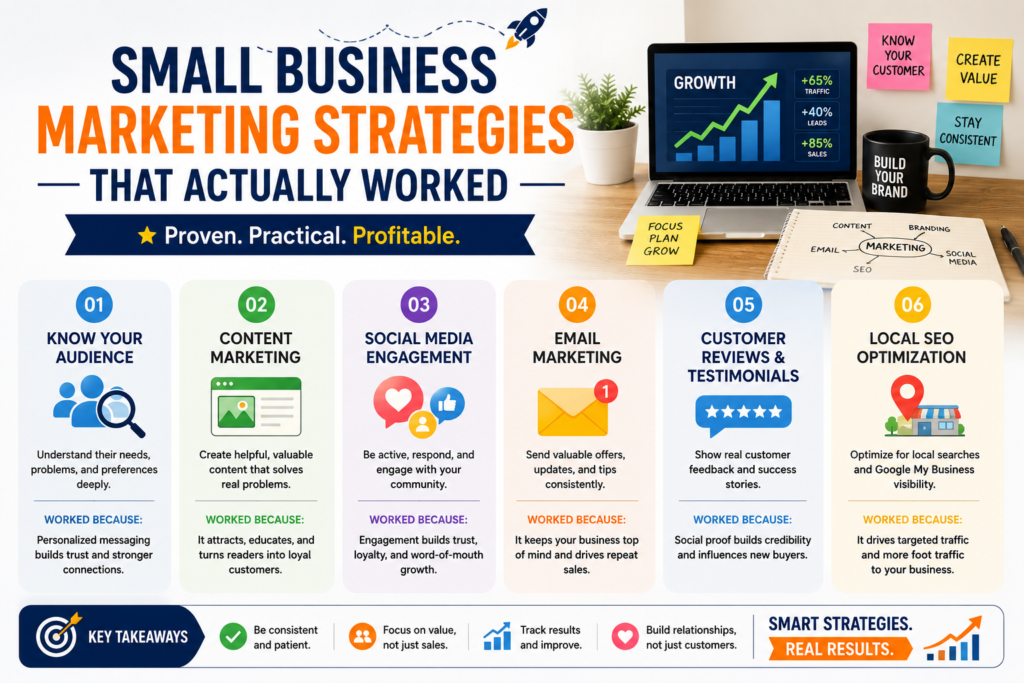
We finally started collecting email addresses at our coffee shop. We simply asked people if they wanted 10% off their next order for signing up. Within two months, we had around 400 people on our list. That list became our most reliable source of repeat sales, far more consistent than any ad campaign we ran.
I use Mailchimp for this. It’s free up to a certain subscriber count, and the templates are simple. Once a week, I send something short. New roast, a small promotion, or a personal update. Open rates on these emails run way higher than anything I’ve gotten from paid ads.
Ask Current Customers for Referrals Directly
We waited too long to do this. For the first year, we just hoped people would tell their friends. Some did. Most didn’t, not because they disliked us, but because it never crossed their mind.
Then we started literally asking. We handed out a small referral card with a discount code for both the referrer and the new customer. Referrals became a real channel instead of a lucky accident. It costs almost nothing. People trust recommendations from friends far more than they trust an ad.
Building an Online Presence Without Losing Your Mind
Social media marketing gets oversold constantly. I fell for the hype early on, thinking we needed to be everywhere at once. Instagram, TikTok, Facebook, Twitter, all running simultaneously. That approach burned me out within a month. It produced mediocre content across every platform instead of good content on one.
Step One: Pick One Platform and Actually Learn It
Instead of spreading thin, pick the platform where your customers spend time. For us, that was Instagram. Coffee is a visually driven product, and our customer base skewed toward regular Instagram users.
I spent a weekend studying how the algorithm favors certain content types. Free YouTube resources helped. I looked for creators who explain the mechanics instead of just saying “post more.” Reels got way more reach than static photos for us. Even simple ones filmed on an iPhone did well.
Step Two: Show the Process, Not Just the Product
Polished product photos got some engagement. Nothing compared to behind-the-scenes content though. Filming the roasting process, showing mistakes when a batch got scorched, talking through why we chose certain beans. That stuff consistently outperformed anything that looked like a traditional ad.
People connect with the humans behind a small business more than a perfect product shot. I didn’t believe this until I posted a chaotic video of us fixing a broken roaster. It was filmed on my phone with terrible lighting. It got triple the engagement of our carefully staged posts.
Step Three: Respond to Every Comment and Message
This one takes actual time. Bigger companies often skip it or hand it to a chatbot. For a small business, personally responding to comments and DMs builds trust that’s hard to replicate any other way.
I block out fifteen minutes each morning just for this. It’s not glamorous work. But customers remember when a business owner actually replies to them personally.
Local Marketing Tactics That Punch Above Their Weight
If your business serves a specific area, local marketing often outperforms broader digital campaigns. It also costs a fraction of the price.
Claim and Optimize Your Google Business Profile
This one is free. I genuinely wish someone had told me to do it on day one instead of month four. We set up a Google Business Profile with accurate hours, photos, and a description. It made a real difference in how often we showed up in local searches.
Encourage customers to leave reviews here specifically, not just on Yelp or Facebook. Google reviews directly affect local search rankings. More reviews genuinely help. You show up higher when someone searches “coffee shop near me.”
Partner With Other Local Businesses
We started a small partnership with a bakery two doors down. We cross-promoted each other on social media and offered a bundled discount for customers who bought from both places. Neither of us spent any money on this. It just took a conversation and a willingness to share audiences instead of competing for the same foot traffic.
This works especially well with businesses that complement yours rather than compete directly. Think a pet groomer partnering with a local vet, or a bookstore partnering with a coffee shop. The overlap in customer base does the heavy lifting.
Sponsor Something Small and Local
Instead of chasing big sponsorship opportunities, we sponsored a local youth soccer team’s jerseys. It cost about two hundred dollars for the season. It didn’t bring in a flood of new customers overnight, but it built genuine goodwill in the neighborhood. Several parents mentioned they started coming in after recognizing our logo from their kid’s uniform.
Paid Advertising, Done Carefully
I’m not against paid ads. My early failure was more about how I used them, not whether they work at all. Once I learned the basics, they became a useful tool instead of money down a drain.
Start With a Small, Specific Budget
Instead of spending three hundred dollars on a broad campaign, I started spending twenty dollars a day. I targeted a narrow radius around our shop, focused on people interested in coffee, local food, or nearby competitor businesses. Facebook’s Ads Manager lets you get quite specific with this. Narrowing the audience made a massive difference in cost per actual customer.
Track What Happens After the Click
This was my biggest early mistake. I ran ads without tracking whether clicks turned into sales. I set up a simple tracking pixel through Facebook and created a unique discount code just for ad traffic. That let me see exactly how many sales came from that twenty dollars a day. Once properly targeted, it was worth every cent.
Retarget People Who Already Showed Interest
Retargeting ads go to people who visited your website or Instagram page but didn’t purchase. They tend to convert at a much higher rate than cold ads to strangers. These people already know you exist. They just need a small nudge, sometimes a limited-time discount, to follow through.
Real Example: How This Played Out Over a Year
Here’s roughly how our marketing evolved over twelve months. Seeing the actual progression might help more than a list of tactics on their own.
Months one through three, we did almost nothing intentional. Just a Facebook page and hope. It didn’t work well, and revenue stayed flat.
Months four through six, we started collecting emails and asking for referrals directly. This is when things started shifting, slowly but noticeably. Repeat customers increased. Our email list became a reliable source of sales during slow weeks.
Months seven through nine, we committed to Instagram, posting behind-the-scenes content three times a week. Engagement grew. Foot traffic from people mentioning they saw us online became a regular occurrence rather than a rare comment.
Months ten through twelve, we added small paid ad campaigns with proper targeting and tracking. We kept up the local partnership and the soccer sponsorship. Revenue was up considerably compared to the same period the year before. Most new customers mentioned a friend’s referral, seeing us on Instagram, or noticing us around the neighborhood.
None of this happened overnight. No single tactic was a silver bullet. It was the combination, applied consistently, that eventually built momentum.
Common Mistakes Small Business Owners Make
Trying to be everywhere at once is probably the most common trap. I fell into it myself early on. Spreading effort across five platforms usually produces mediocre results everywhere, instead of strong results somewhere.
Ignoring the customers you already have while chasing new ones is another mistake. Acquiring a new customer typically costs more than keeping an existing one happy. Yet most small business marketing advice focuses entirely on acquisition.
Skipping tracking and analytics wastes money fast. Running ads or promotions without measuring what converts means repeating the same mistakes. Even basic tracking, like unique discount codes per channel, tells you far more than guessing.
Copying competitors without understanding your own audience rarely works either. What works for a business three blocks away might completely miss your customer base. Their pricing, location, or target demographic could be entirely different from yours.
Giving up too early is the last one. It’s probably the most heartbreaking to watch happen to other small business owners. Marketing usually takes months to show real momentum, not days. Judging a strategy after two weeks often means quitting right before it would have started working.
Adjusting Strategy as Your Business Grows
What worked for us in year one needed adjusting by year two. As our email list grew, generic weekly updates stopped performing as well. So we started segmenting the list by purchase history. Regular customers got different content than people who hadn’t ordered in a while.
Social media content also shifted. Early behind-the-scenes content worked because it was novel. A year later, we had to get more creative. We added customer stories and seasonal content to keep engagement from flattening out.
The lesson here is treating marketing as something that evolves alongside your business. It’s not a strategy you set once and never revisit. What got you your first hundred customers might not get you your next thousand.
Final Thoughts
Marketing a small business without a corporate budget comes down to a few things. Be resourceful. Pay attention to what actually converts. Be willing to show the real, sometimes messy, human side of your business instead of a polished corporate version of it.
None of the strategies here require a marketing degree or a massive budget. They require consistency, a willingness to track what’s working, and enough patience to let strategies build momentum.
Looking back at that sister sitting in a roasting space at 11pm scrolling for answers, I wish someone had told me something simple. Start with the people who already know you exist. Track everything. Be patient. It would have saved a lot of wasted money and a lot of late nights wondering why nothing seemed to work.